

How to choose outdoor lounge furniture for comfort, style, and year-round durability
Key Takeaways
Good outdoor lounge furniture should suit the way you use your space, not just the way it looks in a showroom. Measure carefully, assess the climate, and choose comfort, materials, and maintenance requirements together.
- Measure walkways, doorways, and furniture clearances before buying.
- Choose seating around how you relax, dine, and entertain.
- Compare frames, finishes, fabrics, and cushion construction for your climate.
- Test comfort and proportions rather than relying on photographs alone.
- Protect, clean, and store furniture according to its materials.
Define your outdoor lounge area and how you use it
Start with the space and your habits, then choose the furniture. A compact balcony, covered deck, poolside terrace, and open lawn each place different demands on a seating arrangement. Think about who uses the area, when you use it, and whether you want one flexible setting or several dedicated zones.
Measure the space and plan clearances
Measure the full usable area, including posts, steps, doors, railings, and fixed planters. Mark the footprint of possible sofas and chairs with tape or flattened cardboard so you can judge the scale before delivery. Allow room to pull a chair out, walk behind seating, open doors, and move around a coffee table without squeezing past someone’s knees.
A little extra clearance also makes cleaning and seasonal rearranging easier. If you are furnishing a narrow balcony or apartment terrace, look for shallower seating and pieces that can be moved without dismantling the entire arrangement.
Match furniture to dining, relaxing, or entertaining
Your main activity should determine the seat style and height. A deep sofa works well for reading or long conversations, while more upright chairs may be better when you regularly eat outdoors. If guests come often, combine a central sofa with movable chairs, ottomans, or a bench rather than filling every inch with one large fixed piece.
Consider the small rituals too: morning coffee, afternoon sun, outdoor meals, and evening drinks all call for slightly different support. A useful outdoor furniture buying guide can help you think through comfort, materials, and everyday features before you commit to a collection.
Consider sun, wind, rain, and surrounding features
Observe the area at different times of day. Strong afternoon sun can make dark cushions uncomfortable, while prevailing wind may shift lightweight chairs or carry rain into a supposedly sheltered corner. Nearby trees add shade but may also drop pollen, leaves, sap, or debris onto cushions.
Also note drainage, outdoor heaters, umbrellas, fireplaces, and pool edges. Keep fabric away from direct heat sources, avoid blocking water run-off, and choose heavier or more stable pieces for exposed locations. The best outdoor lounge furniture feels naturally placed because it works with the conditions around it.
Create a practical layout for conversation and movement
Arrange seats so people can see one another without twisting, and keep the main walking route obvious. A sofa facing two chairs creates an easy conversational triangle; a chaise can sit slightly apart for reading. Place a table within comfortable reach, but leave enough room for legs and for serving trays to pass through.
Before ordering, sketch the layout from above and from the main doorway. That simple check often reveals that a smaller sofa plus one flexible chair will work better than a bulky sectional.
Choose the right types of outdoor lounge furniture
Outdoor seating comes in more forms than the familiar sofa-and-table combination. Sofas establish a social anchor, chairs provide flexibility, and ottomans can change from footrest to spare seat in seconds. Choose a mix that supports your actual routine while leaving enough open space for movement.
Compare outdoor sofas, sectionals, and loveseats
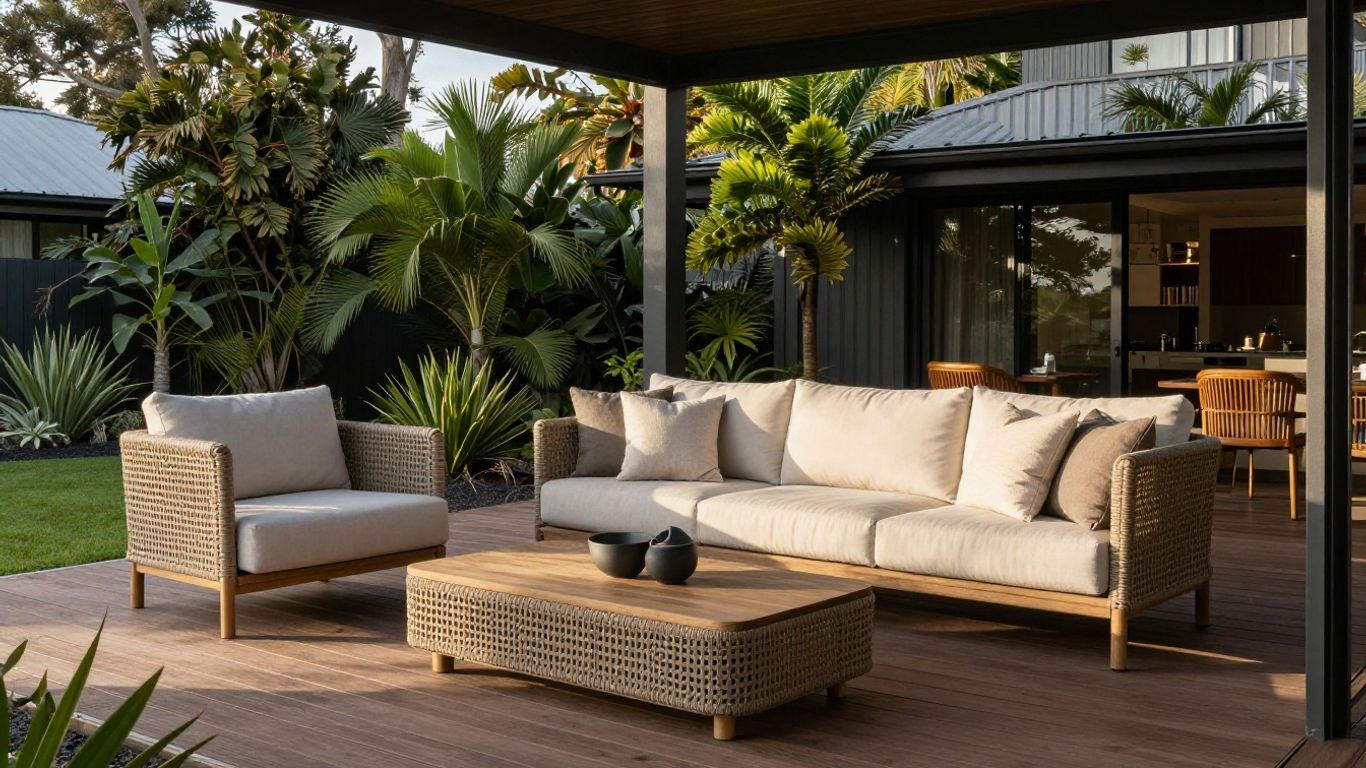
A sofa is a straightforward choice when you know where it will stay and how many people it needs to seat. A loveseat suits smaller terraces or a pair of lounge chairs, while a sectional can define a generous corner and provide more continuous seating. Check the overall depth, arm width, and configuration, not only the advertised seat count.
For a compact setting, the Opito Double Sofa is described with a compact footprint, adjustable feet, and a handwoven UV-resistant nylon rope design. Those documented details illustrate why dimensions and levelling features matter as much as appearance when you are fitting seating into a smaller area.
Select lounge chairs, recliners, and chaise lounges
A lounge chair gives you a personal retreat and can be repositioned as the sun moves. Recliners and chaises are useful when you want to read, nap, or stretch out, but their moving parts and extended footprint need extra clearance. Check whether the chair supports your preferred posture rather than assuming a deep seat will automatically feel comfortable.
A chair with a swivel or rocking function can add movement, although it may need a stable, level surface. When comparing options, look at the back angle, arm height, cushion support, and how easily you can get in and out.
Add ottomans, benches, and flexible accent seating
Small pieces often make a seating plan more adaptable. An ottoman can support your feet, hold a tray, or provide occasional seating, while a bench can accommodate several people along a wall. Choose pieces that are light enough to move but stable enough not to wander in the wind.
The Sunbrella Round Pouf Ottoman is presented as a footrest, extra seat, or side table, which is the kind of multi-use role that earns its space on a busy deck. Use one or two flexible pieces rather than collecting accents that simply add clutter.
Decide whether modular furniture suits your space
Modular furniture makes sense when your layout may change or when you want to build a setting in stages. You can often separate pieces for different activities, bring them together for guests, or adapt the arrangement after moving house. The trade-off is that connectors, joins, and individual modules need to be checked carefully for stability and visual continuity.
Before choosing modular seating, measure every possible configuration and confirm how the pieces lock together. It is a particularly practical approach for evolving patios, but a fixed sofa may be simpler if the layout is settled.
Evaluate materials for durability and maintenance
Material choice affects appearance, comfort, cleaning, weight, and service life. There is no single best frame or finish for every outdoor setting; the right choice depends on exposure, drainage, storage, and how much care you are willing to provide. Look at the frame, outer finish, fabric, foam, and fasteners as a complete system.
Compare aluminum, steel, teak, and other frame materials
Aluminum is light and practical for furniture you may move, while powder-coated finishes can add a protective surface. Steel can feel substantial, but you should confirm how it is treated against corrosion. Teak brings warmth and a natural grain, and its appearance changes over time depending on whether you clean, oil, or leave it to weather.
Ask how joints are constructed and whether feet keep the frame clear of standing water. The 3 F's of buying durable outdoor furniture offers a useful way to assess frame, fabric, and foam together rather than judging a product by its frame material alone.
Understand wicker, rope, and synthetic outdoor finishes
Wicker is a woven appearance rather than one single material, so identify whether the strands are intended for outdoor exposure and how they are attached. Rope creates texture and visual softness, but the weave can collect dust and may need careful brushing. Synthetic finishes are generally selected for weather exposure, yet their quality still depends on construction and maintenance.
Look closely at edges, underside details, and areas where water might collect. A cleanable finish is helpful, but it does not remove the need for ventilation and sensible placement.
Choose fabrics that resist fading, moisture, and mildew
Outdoor fabric should suit the amount of sun and rain your furniture receives. Look for clear information about UV resistance, fading, moisture behaviour, and mildew resistance, then check whether cushion covers can be removed for cleaning. A pale fabric may look airy, but a textured mid-tone can be more forgiving in a leafy or high-use setting.
Cushion interiors matter as much as the cover. Quick-dry or free-draining construction can reduce water retention, provided the cushions also have somewhere breezy to dry after heavy rain. For a chair-sized option, the Arrowtown Chair is described with Sunbrella Marble fabric, a rust-proof aluminum frame, and Quick Dry Foam.
Balance weather resistance with cleaning requirements
A material can be weather-resistant and still require regular care. Woven surfaces may need a soft brush, wood may need periodic attention to preserve a chosen finish, and cushions should not be left damp for long periods. Ask yourself whether you prefer furniture that can stay outside or whether you are happy to cover and store it.
| Material or feature | Useful advantage | Maintenance question |
|---|---|---|
| Aluminum frame | Light and easy to move | Is the finish intact around joints and feet? |
| Teak frame | Warm natural appearance | Do you want it to weather or retain its original tone? |
| Outdoor fabric | Colour and comfort in exposed areas | Can covers be removed and cleaned? |
| Quick-dry foam | Helps water pass through the cushion | Where will cushions dry after rain? |
The table is a starting point, not a substitute for the product specifications. Match the construction to your exposure and your available storage, then choose the option you can realistically maintain.
Prioritize comfort and ergonomic design
Comfort is personal, but it can be assessed more carefully than a quick sit in a showroom suggests. Seat depth, height, back angle, arm position, and cushion support all affect how long you will want to stay outside. Try to imagine the furniture during your real routines, from upright conversation to a slow afternoon read.
Check seat depth, height, and cushion support
A deep seat can feel luxurious if you like to curl up, but it may be awkward for shorter users or for upright dining. A higher seat can make standing easier, while a lower profile may feel more relaxed. Sit fully back and check whether your feet rest comfortably on the floor and whether the cushion supports your lower back.
Armrests should let your shoulders relax rather than forcing them upward. If several people will use the setting, test more than one seat and avoid designing around only one person’s proportions.
Choose cushion thickness and foam performance
Thicker cushions are not automatically better. The quality and density of the foam, the way it is wrapped, and how quickly it drains can matter just as much as the visible thickness. Ask how the cushion behaves after repeated use and whether it is designed for outdoor drying.
For a weather-exposed sofa, the Tasman Alu Double Sofa is described with quick-dry foam cushion cores, powder-coated frames, and Sunbrella fabric. Those are specific features to evaluate in a product listing, not assumptions to apply to every outdoor cushion.
Use pillows and throws without creating clutter
Pillows can adjust lumbar support and add colour, while a throw makes a cool evening more inviting. Keep the number proportional to the seating and leave room to sit without moving a pile of accessories first. Choose washable or outdoor-suitable covers, especially if the area is open to rain and dust.
A restrained group of cushions usually looks more considered than a crowded arrangement. Repeat one or two colours, then let the frame and upholstery provide the larger visual shapes.
Test furniture for different body types and uses
If possible, have different household members sit, recline, and stand from the furniture. Check how the seat works for taller users, shorter users, children, and anyone who needs firmer support. Also test the practical details: can you reach the table, shift position, and get out without pushing against another seat?
Online shoppers can compare stated dimensions with a chair or sofa at home. A paper template or masking-tape outline gives you a useful sense of depth before delivery, though it cannot replace trying the actual cushion feel.
Coordinate style, colors, and proportions
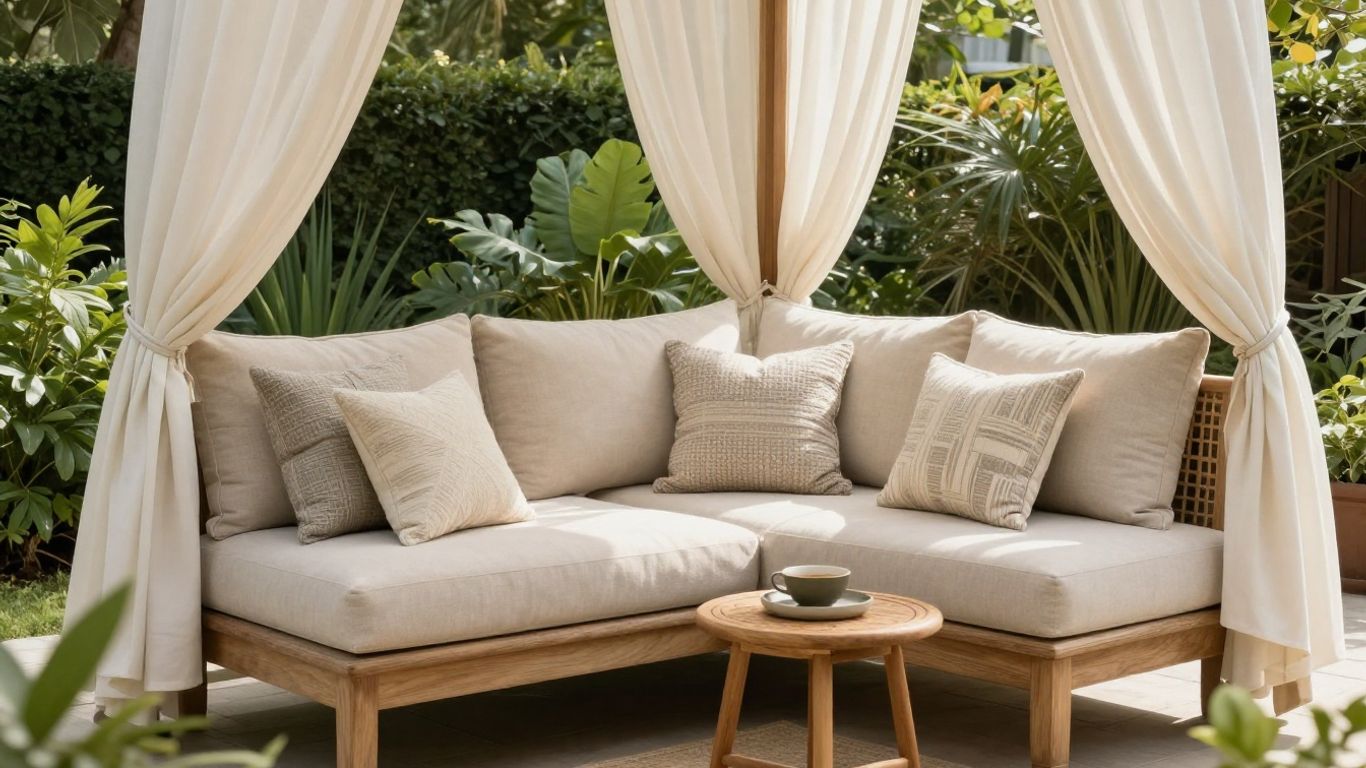
A successful outdoor room feels connected to the home without looking like an indoor room placed outside. Start with the architecture, existing paving, planting, and nearby views. Then use furniture shape, colour, and texture to create a setting that feels intentional but still relaxed.
Build a cohesive outdoor color palette
Choose a base colour for the largest pieces, a supporting tone for cushions or rugs, and one smaller accent. Neutrals are easy to refresh, while earthy greens, warm browns, and soft blues can sit comfortably beside planting and timber. Consider how colours change in strong sunlight and shade before ordering.
You do not need every item to match exactly. Repeating one fabric tone or frame finish is usually enough to make separate pieces feel related.
Match furniture scale to the patio or deck
Large furniture can make a generous terrace feel comfortable, but it can overwhelm a narrow deck. Conversely, small chairs scattered across a broad area may look lost and fail to create a useful social zone. Compare the furniture height with nearby doors, balustrades, walls, and planting so the composition has a natural rhythm.
Leave some breathing room around the arrangement. Open space is part of the design and makes the setting easier to use.
Combine textures for a layered look
Texture gives an outdoor setting depth without requiring bright colour. Pair a smooth powder-coated frame with woven rope, timber, textured upholstery, or a simple outdoor rug. Balance rough and soft surfaces so the arrangement feels tactile but not visually noisy.
Repeat textures at different scales rather than using one pattern everywhere. A woven chair, a plain sofa, and a small textured cushion can be enough to create variation.
Adapt popular styles to your home’s architecture
Modern homes often suit clean lines and restrained colour, while older homes can carry natural timber, rounded profiles, or more decorative details. Coastal, resort, and minimalist styles can all work when they respond to the building rather than being copied wholesale.
Use the architecture as a filter. Select the details you genuinely like, then keep the proportions and palette consistent with the surrounding home.
Plan your budget and buying strategy
Set your budget around a complete usable area, not one headline piece. Include seating, tables, cushions, covers or storage, delivery, and assembly where applicable. A considered plan helps you compare a smaller high-quality setting with a larger arrangement that may cost more to maintain.
Set a realistic budget for a complete seating area
List the essentials first: the main seating, a surface for drinks, and enough shade or lighting for the way you use the area. Add optional pieces after you have confirmed the layout. This prevents accessories from consuming the budget before the basic seating is comfortable.
Also allow for replacement covers, cleaning supplies, and occasional repairs. The lowest purchase price may not be the lowest cost if the furniture needs frequent replacement.
Compare value across materials and construction quality
Read beyond the colour and dimensions. Check frame treatment, cushion filling, fabric performance, joinery, adjustable feet, hardware, and the care instructions. A well-built piece with suitable weather resistance can offer better value than an inexpensive item that cannot handle your exposure.
Compare like with like and record the details in one place. Warranty length is useful, but understand what it covers and whether fabric, frames, and workmanship have separate terms.
Decide when custom or modular options are worthwhile
Custom or modular furniture is worth considering when your space has unusual dimensions, changing needs, or a layout that must work around fixed features. It can help you use a difficult corner or build the setting in stages. For a simple rectangular patio with a settled layout, standard sizes may provide better value and faster delivery.
Make the decision based on fit and future use, not novelty. A flexible configuration only helps if you are likely to rearrange it.
Check warranties, delivery, assembly, and return policies
Before ordering, confirm delivery access, lead times, assembly requirements, packaging removal, and return conditions. Measure gates, stairs, lifts, and door openings, and ask how the item will arrive if it is fully assembled. Keep the invoice and care instructions with your household records.
For New Zealand shoppers, a modern outdoor furniture guide can provide another useful checklist for assessing frames, foams, fasteners, comfort, and care. The more clearly you understand the purchase before checkout, the fewer surprises you are likely to face.
Protect and maintain your outdoor lounge furniture
Even durable furniture lasts better when it is placed and cared for thoughtfully. Maintenance begins with drainage and ventilation, then continues with regular cleaning and sensible seasonal preparation. Follow the care instructions for each material instead of treating the entire setting as one surface.
Use covers and storage to extend furniture life
Covers can reduce exposure to dust, leaves, bird mess, and strong sun, while storage protects cushions and smaller pieces during severe weather. Choose breathable covers that fit securely rather than trapping dampness underneath. Before covering anything, let wet fabric dry and clear debris from the frame.
If your furniture is designed to remain outside, covers may still be useful during long periods of non-use. Store pillows and throws separately so they do not hold moisture against the upholstery.
Clean frames, cushions, and upholstery correctly
Remove loose dirt with a soft brush, then use a mild cleaning solution where the care instructions allow it. Rinse thoroughly and let cushions dry upright in moving air. Avoid aggressive scrubbing, unapproved solvents, and high heat, which can damage finishes or fabric.
Clean small marks promptly rather than waiting for them to become embedded. Check seams, feet, fasteners, and the underside of cushions during the same routine.
Prepare furniture for seasonal weather
Before a wet or windy season, inspect the layout and move lightweight pieces to a sheltered position. Clear drains, tighten accessible hardware, and check that furniture is not sitting in pooled water. In colder or stormier periods, store cushions and removable accessories even if the main frame stays outdoors.
A short seasonal checklist keeps care manageable:
- Brush leaves and debris from frames and fabric.
- Check feet, joints, fasteners, and drainage points.
- Wash and dry removable covers before storage.
- Secure or relocate lightweight chairs during strong winds.
After completing those checks, give the furniture time to dry fully before covering or storing it. Small habits prevent dampness and grime from becoming larger problems.
Replace cushions, hardware, and smaller components when needed
You do not always need to replace an entire setting when one component wears out. Faded or flattened cushions, loose feet, damaged glides, and corroded hardware can often be addressed individually, depending on the product and its warranty. Contact the retailer or manufacturer with photographs, purchase details, and the item dimensions.
Replacing a small part also gives you a chance to reassess comfort. A new cushion insert or a better-positioned foot can restore everyday use without changing the whole layout.
Conclusion
Choosing outdoor lounge furniture becomes much easier when you treat the space, climate, comfort, appearance, budget, and maintenance as one decision. Measure first, test the way you will actually sit, inspect the construction, and buy only what you can protect and enjoy throughout the year.
Frequently Asked Questions
What is the best material for outdoor lounge furniture?
The best material depends on your exposure, preferred appearance, available storage, and willingness to maintain it. Compare the complete construction, including frame treatment, fabric, foam, fasteners, and drainage, rather than choosing by material name alone.
How much space should you leave around outdoor seating?
Leave enough room to walk comfortably, pull chairs out, open nearby doors, and reach tables without bumping into other furniture. Use tape or cardboard outlines to test the arrangement before ordering.
Can outdoor lounge furniture stay outside all year?
Some furniture is designed for year-round outdoor use, but exposure still affects cleaning and service life. Covers, dry storage for cushions, good drainage, and seasonal checks can help protect the setting.
Are deep outdoor sofas comfortable for everyone?
Deep sofas can be excellent for reclining, but they may feel awkward for shorter users or anyone who prefers upright support. Check seat depth, height, back angle, and cushion firmness with the whole household in mind.
How do you prevent outdoor cushions from becoming damp?
Choose breathable, quick-drying or free-draining cushion construction where appropriate, keep cushions ventilated, and let them dry upright after rain. Do not cover or store them while they are still wet.
Should you buy a sectional or separate outdoor chairs?
A sectional can anchor a large corner and provide continuous seating, while separate chairs are easier to move and rearrange. Base the choice on your room shape, entertaining habits, storage, and whether the layout is likely to change.
How often should outdoor furniture be cleaned?
Light debris should be removed regularly, while a deeper clean can be scheduled when surfaces look soiled or before seasonal storage. Always follow the care instructions for the specific frame, fabric, wood, and cushion materials.